
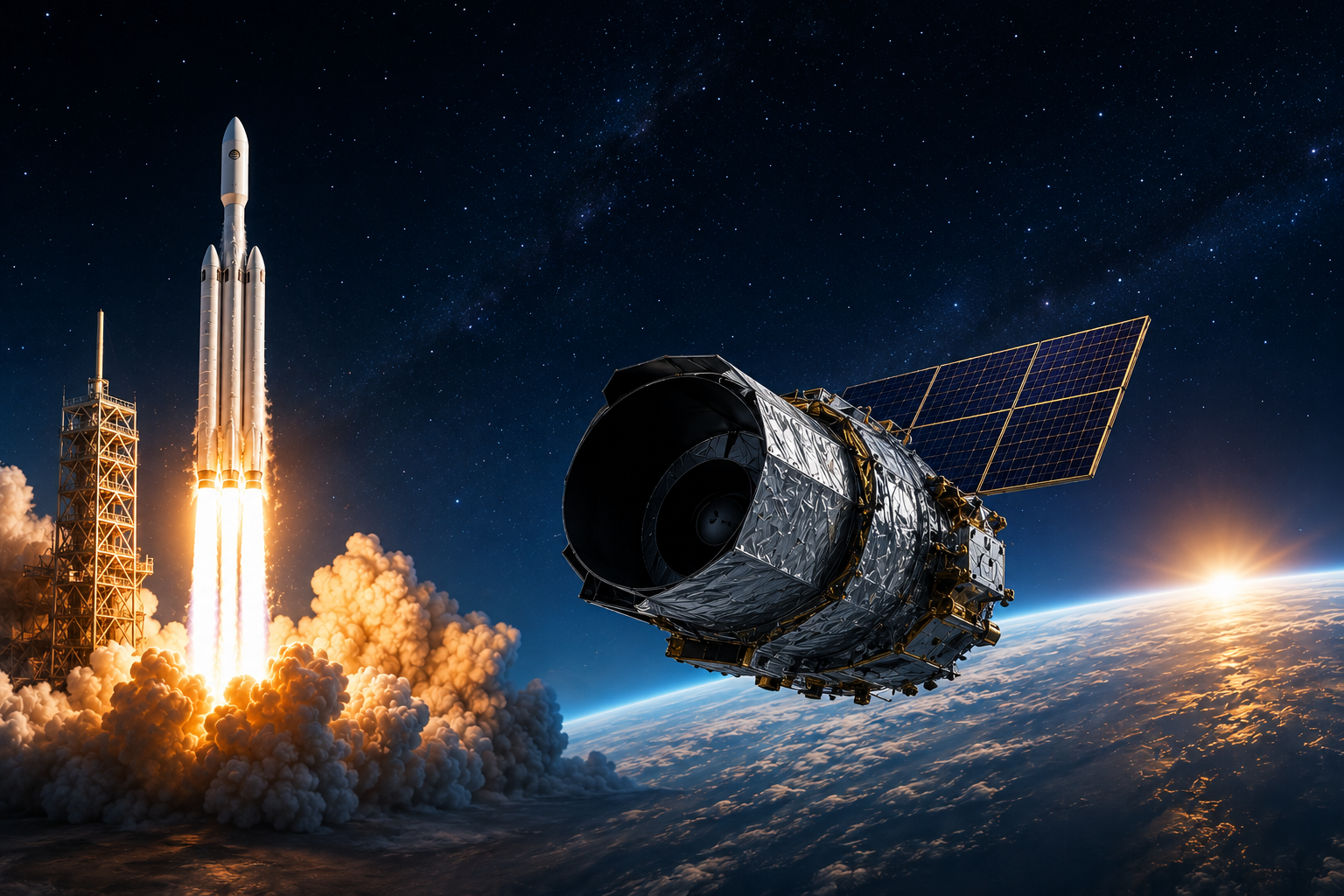
From Launch to L2
The launch is only the beginning of Roman’s journey. The spacecraft is now travelling roughly one million miles toward the second Sun-Earth Lagrange point, known as L2. At this location, the combined gravitational effects of the Sun and Earth allow the observatory to maintain a relatively stable orbit while using comparatively little fuel.
The journey is expected to take about three months. During this period, NASA will carry out a series of deployments, instrument activations, calibrations and tests before Roman begins its scientific observations. NASA currently expects to release the telescope’s first science images in early 2027.
A Telescope Built for Wide Surveys
One of Roman’s biggest differences is the amount of sky it can observe at once. Its Wide Field Instrument will provide image sharpness comparable to Hubble while covering a field of view at least 100 times larger. This means Roman can survey much larger areas of the sky in a shorter period, giving astronomers a way to study enormous populations of galaxies and other objects rather than focusing on only a small region at a time.
This wide view is important because many astronomical questions require large amounts of data. Instead of studying individual galaxies or planetary systems one at a time, Roman will collect large surveys that can reveal patterns across the universe.
Looking for Dark Energy and Dark Matter
One of Roman’s main scientific goals is to investigate dark energy and dark matter, two major components of the universe that remain poorly understood. Astronomers know that the expansion of the universe is accelerating, but the physical cause behind this acceleration is still an open question. Roman will study large numbers of distant galaxies and exploding stars to help researchers examine how the universe has expanded over time.
The telescope will also contribute to studies of dark matter. Although dark matter cannot be directly observed with ordinary light, its gravitational influence affects the distribution and movement of visible matter. By mapping large areas of the sky, Roman can help researchers investigate how this invisible component has shaped cosmic structures.
Looking Beyond Our Solar System
Roman will also search for planets beyond our solar system. Its Coronagraph Instrument, developed as a technology demonstration, is designed to block out the intense light from stars so that much fainter objects orbiting those stars can be studied. This could help demonstrate technologies needed for future missions aimed at directly imaging planets around other stars.
The mission will also conduct a statistical survey of planetary systems, giving scientists a broader picture of how common different types of planets and planetary systems may be.
What Happens Before the Science Begins
Although Roman has reached space, it will not immediately begin sending back its main scientific observations. The next phase involves carefully deploying and checking the spacecraft's systems. NASA will calibrate the instruments and test their performance during the journey to L2. Only after this commissioning period will Roman begin its planned science programme.
This stage is important because a space telescope cannot simply be switched on after launch. Its instruments need to operate precisely in a very different environment from Earth, and even small alignment or calibration issues can affect the quality of the observations.
A New View of the Universe
Roman's launch marks the beginning of a mission designed to collect an enormous amount of astronomical data over at least five years. Its wide field of view, infrared capabilities and technology demonstrations will allow it to investigate questions ranging from the expansion of the universe to planets orbiting distant stars.
For now, however, Roman's next destination is L2. The most important part of the mission is still ahead: reaching its orbit, completing commissioning and eventually turning its instruments toward the sky. What it finds could add another layer to what scientists already know about the universe.
Career Takeaway
The Roman mission highlights careers in astronomy, astrophysics, aerospace engineering, optical engineering, instrumentation, spacecraft operations and data science. Large space observatories also require specialists who can design, test and calibrate instruments before they can produce scientific data.
Useful Statistics
- August 30, 2026: NASA Nancy Grace Roman Space Telescope launched aboard a SpaceX Falcon Heavy.
- 1 million miles: Roman will travel roughly one million miles to reach the Sun-Earth L2 region.
- 100 times: Roman’s Wide Field Instrument has a field of view at least 100 times larger than Hubble.