
How Nuclear Thermal Propulsion Works
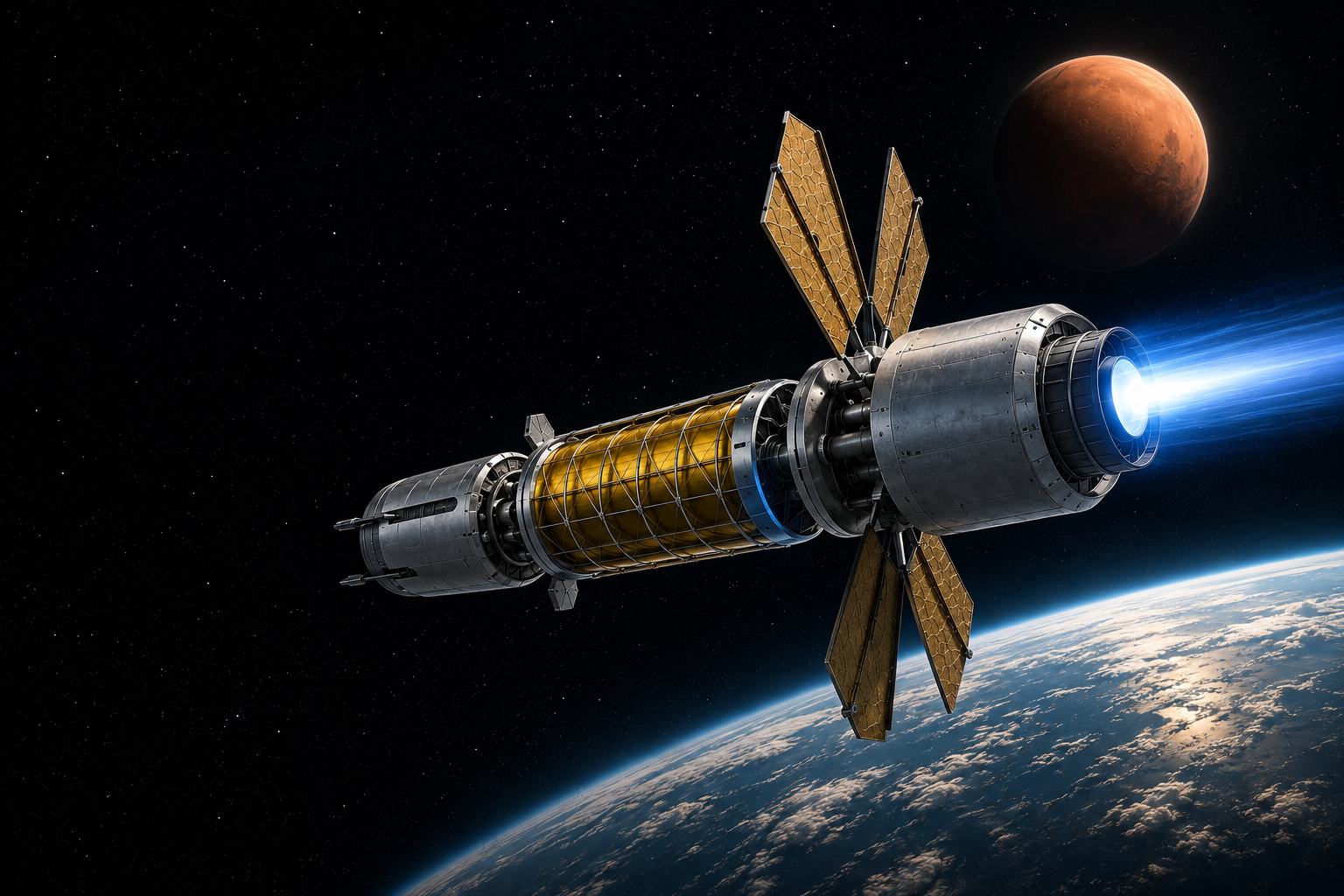
NTP uses heat from a nuclear fission reactor instead of chemical combustion to produce thrust. In a typical design, liquid hydrogen passes through a reactor core and absorbs the heat generated by fission. The hydrogen expands into a hot gas and is then expelled through a nozzle, creating thrust.
The basic idea is relatively straightforward, but the operating conditions are demanding. NASA describes NTP as a system capable of providing high thrust at roughly twice the propellant efficiency of chemical rockets. That combination is what makes the technology attractive for missions that require both strong acceleration and efficient use of propellant.
What Could It Change?
For deep-space missions, improved propellant efficiency could give spacecraft more flexibility. Less propellant could mean more room for scientific instruments, crew supplies or other mission equipment. Alternatively, mission designers could use the available propellant to pursue faster trajectories.
NASA technical studies have examined NTP for missions beyond Mars, including potential missions to Jupiter and Uranus. In those studies, NTP-powered mission designs showed the potential to deliver considerably more payload than comparable chemical-propulsion architectures. The exact advantage, however, depends on the spacecraft, trajectory and mission requirements.
Mars is another important application. A shorter journey could reduce the time astronauts spend in deep space, where they face challenges such as radiation exposure and the need to carry supplies for long periods. NTP has therefore been considered as one possible technology for future human Mars missions.
The Engineering Challenge
The potential benefits of NTP come with difficult engineering problems. A reactor must operate at extremely high temperatures while hydrogen flows through the system. Materials and fuel elements must survive these conditions without losing their structural strength or performance.
NASA has identified reactor operation above 2,800 kelvin in a flowing hydrogen environment as a major technology challenge. Developing suitable reactor components, fuel and testing methods is therefore essential before the theoretical advantages of NTP can translate into a reliable flight system.
What Comes Next
Nuclear thermal propulsion is not simply a replacement for chemical rockets. Its value lies in the possibility of combining high thrust with improved propellant efficiency, potentially giving future spacecraft greater freedom in how they travel through deep space.
The technology still has significant engineering and testing challenges to overcome. Whether those challenges can be resolved well enough for NTP to become a practical part of future missions remains open. For now, nuclear thermal propulsion represents a promising possibility in the search for more capable ways to travel beyond Earth's immediate neighbourhood
Career Takeaway
The development of nuclear thermal propulsion creates opportunities across aerospace engineering, nuclear engineering, materials science and propulsion research. Engineers working in this area need to understand both spacecraft systems and the extreme conditions inside a nuclear reactor. As NTP research moves toward more advanced testing, expertise in reactor design, high-temperature materials, propulsion systems and safety could become increasingly relevant to future deep-space missions.
Useful Statistics
- NASA describes NTP as providing approximately twice the propellant efficiency of chemical propulsion while maintaining high thrust.
- NASA identifies reactor operation above 2,800 kelvin in flowing hydrogen as a major NTP technology challenge.
- A NASA technical study found that, under specific mission assumptions, NTP-powered missions to Jupiter or Uranus could deliver approximately 2.4 to 3.6 times the payload of comparable chemical-propulsion missions.
- NASA technical material gives approximately 900 seconds as a representative specific impulse for NTP, compared with substantially lower values for conventional chemical propulsion.