
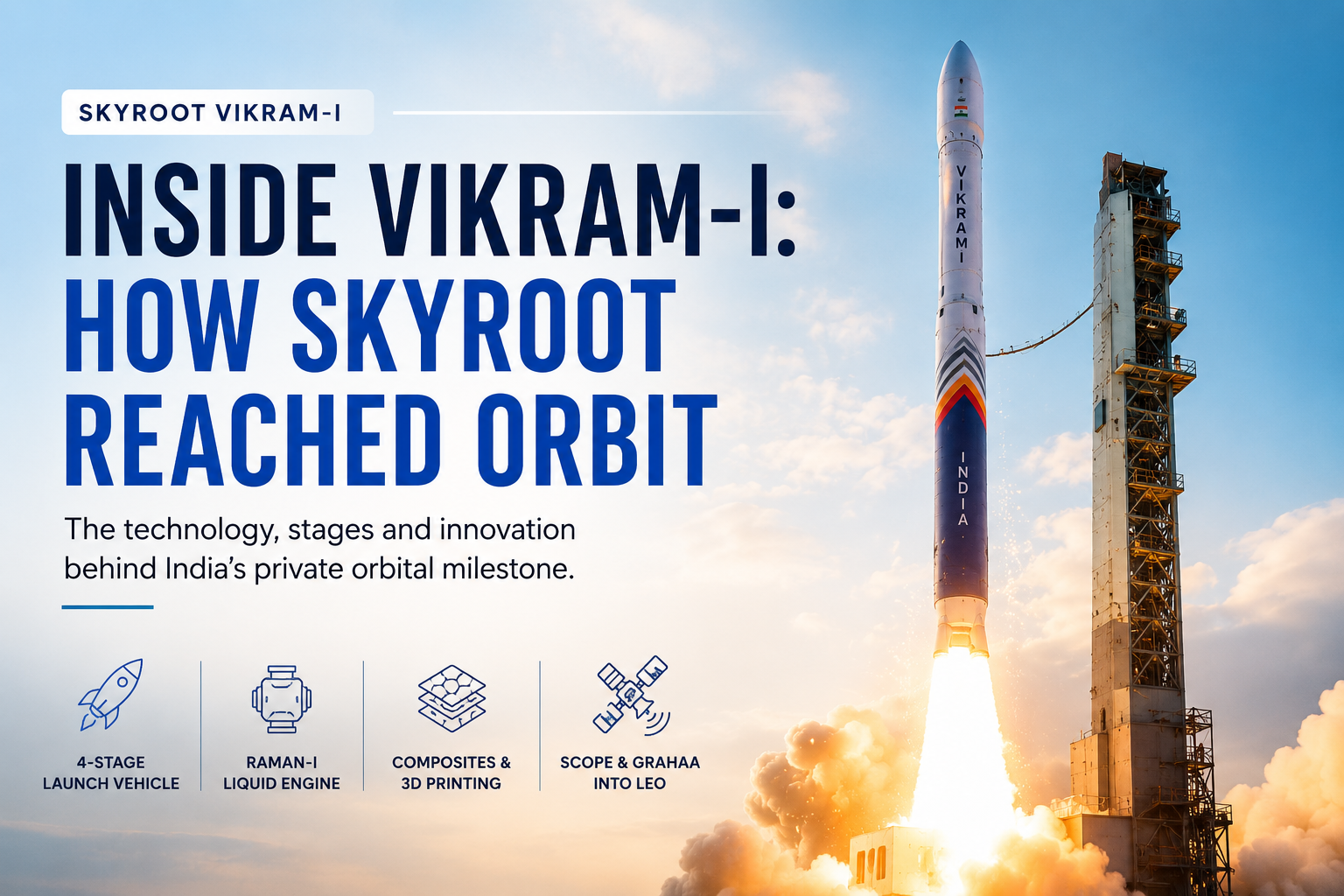
A Four-Stage Rocket Built for Small Satellites
Vikram-I is a four-stage launch vehicle with three solid stages and one liquid upper stage. ISRO identifies the liquid engine used in the upper stage as Raman-I.
In a multi-stage rocket, the stages work in sequence. The earlier stages provide the thrust needed during the initial part of the flight. Once their work is complete, they can be separated from the vehicle, reducing the mass that the remaining stages have to accelerate. The upper stage then provides the propulsion needed for the final part of the ascent and orbital insertion.
This arrangement is particularly important for a launch vehicle because reaching orbit requires more than simply travelling upward. The vehicle must also build enough horizontal velocity for the payload to remain in orbit around Earth.
What the Solid Stages Do
The first three stages of Vikram-I use solid propulsion. Their main role is to provide the high thrust required during the early and middle portions of the flight.
According to ISRO, the first-stage solid motor was cast and tested at ISRO's facilities at Sriharikota, while the second-stage motor was also validated at the same static-test facility. The involvement of these facilities shows how Vikram-I combined private-sector vehicle development with access to established national space infrastructure.
Why the Liquid Upper Stage Matters
The fourth stage uses the Raman-I liquid engine, which powers Vikram-I's liquid upper stage. ISRO reports that the engine was tested at the Liquid Propulsion Systems Centre (LPSC) before the mission.
The upper stage is important because the final part of a launch requires precise control of the vehicle's motion. Reaching orbit involves building sufficient horizontal velocity, not simply gaining altitude. For Vikram-I, the liquid upper stage therefore forms an important part of the vehicle's final ascent and orbital-insertion process.
Composite Structures and Additive Manufacturing
Skyroot describes Vikram-I as using an all-carbon-composite structure and identifies a 3D-printed liquid engine among its technologies. Carbon composites can provide structural strength while keeping weight relatively low. Additive manufacturing, meanwhile, can be used to produce components with complex geometries.
These technologies are part of the vehicle's overall engineering approach. They should not, however, be presented as the sole reason for the mission's success. The launch depended on the integration of propulsion, structures, avionics, vehicle operations and other systems.
From Vikram-S to Vikram-I
Vikram-S, Skyroot's 2022 suborbital test vehicle, provided an earlier demonstration of technologies that fed into the Vikram programme.
ISRO reported that Vikram-S reached approximately 89.5 km in 155 seconds. Skyroot separately reported figures of 88.8 km, Mach 5.07 and a total flight duration of 301.4 seconds. Because the two sources report different measurements, these figures should remain clearly attributed to their respective sources rather than being treated as interchangeable.
Skyroot describes Vikram-S as using an all-carbon-composite airframe and validating technologies including solid propulsion, avionics and telemetry. These earlier demonstrations provided part of the development path toward Vikram-I.
ISRO and IN-SPACe Support
Vikram-I was privately developed, but its launch also depended on India's wider space infrastructure. ISRO reports that it provided access to solid-motor casting and static-test facilities at Sriharikota. It also supported activities including stage preparation, material handling, transportation, vehicle integration and trajectory analysis.
ISRO's safety team monitored operations at the site during pre-launch and launch activities. This support illustrates how private space companies can develop launch vehicles while working with existing national infrastructure and technical facilities.
IN-SPACe's Complementary Role
IN-SPACe played a complementary role within India's private-space framework. The organisation helped enable private participation in space activities through regulatory and promotional functions. According to the source used for this article, its role included helping Skyroot access ISRO facilities, technical consultancy, mission-readiness reviews and launch clearances.
The distinction between the roles is important: Skyroot developed the launch vehicle, while ISRO and IN-SPACe contributed infrastructure, technical support and regulatory facilitation within India's wider space ecosystem.
What the Vikram-I Mission Means for India's Private Space Sector
The Vikram-I mission demonstrates that a private Indian company can take a launch vehicle from development to orbital flight while operating within India's existing space infrastructure. The mission is also significant because it was achieved on Skyroot's first attempt at an orbital launch. However, one successful launch does not by itself establish a repeatable launch service.
The next challenge is turning a successful demonstration into reliable and repeatable launch operations. Skyroot markets Vikram-I for small-satellite deployments and lists dedicated and rideshare launch options.
The engineering work behind such a programme extends beyond the rocket itself. It involves areas including aerodynamics, guidance, navigation and control, vehicle integration, liquid propulsion, avionics and composite manufacturing.
Career Takeaway
For students interested in aerospace, Vikram-I shows that a rocket programme depends on more than one engineering discipline. Relevant pathways include propulsion and engine testing, composite materials, avionics, guidance and control, vehicle integration, manufacturing and launch operations.
A practical starting point is to build one technical skill, learn how it connects to the wider launch system, and gain project or laboratory experience that demonstrates that skill.
Useful Statistics
Vikram-I orbital launch from Satish Dhawan Space Centre, Sriharikota.
Vikram-I liftoff time reported by ISRO.
Three solid stages and one liquid upper stage.
SCOPE and Grahaa injected into Low Earth Orbit.
Vikram-S Mission Prarambh.
Vikram-S figures reported by ISRO.
Vikram-S figures separately reported by Skyroot.